The global silver jewelry market is projected to reach USD 43.76 billion in 2026, growing to USD 65.43 billion by 2035 with a CAGR of approximately 4.6%. Asia-Pacific accounts for over 40% of global consumption. Sterling silver (925) jewelry alone is valued at USD 16.96 billion in 2026, projected to reach USD 27.23 billion by 2035 at a 5.4% CAGR.
Bali Silver Jewelry Wholesale vs. Thai Silver in 2027: A Detailed Look at Craftsmanship, Pricing, and Durability Standards
As senior content lead for Bali Silver Jewelry Wholesale, I provide this detailed comparison for importers, wholesalers, retailers, interior contractors, and trade buyers evaluating sourcing options in Southeast Asia for 2027. We focus on craftsmanship, pricing structures, and durability standards, drawing on market data for 2026-2027.
1. Market Size & Growth: Global, Asia-Pacific, and Indonesia/Bali (2026-2027)
The global silver jewelry market is experiencing robust growth. By 2026, its value is projected to reach USD 43.76 billion, with forecasts indicating a rise to USD 65.43 billion by 2035, at a Compound Annual Growth Rate (CAGR) of approximately 4.6% between 2026 and 2035. Global silver jewelry fabrication exceeded 240 million ounces in 2023 and is anticipated to reach around 248.6 million ounces by 2026, marking the highest demand in over a decade.
Asia-Pacific Dominance in Silver Jewelry Consumption
The Asia-Pacific region is a primary driver of this growth, accounting for over 40% of global silver jewelry consumption. This positions it ahead of North America, which holds approximately 38%, and Europe, with around 20% of the market share. This regional demand is crucial for wholesale buyers considering sourcing from Asian markets.
Sterling Silver (925) Segment Growth
Within the broader market, the sterling silver jewelry segment (925 purity) is a significant contributor. Valued at USD 16.09 billion in 2025, it is projected to reach USD 16.96 billion in 2026. This segment is expected to grow to USD 27.23 billion by 2035, demonstrating a CAGR of 5.4% from 2026 to 2035. This sustained growth indicates strong consumer preference for sterling silver products.
Indonesia/Bali Positioning in 2026-2027
Indonesia’s sterling silver jewelry market, particularly in Bali and Yogyakarta, is characterised by its emphasis on cultural craftsmanship and heritage-based motifs. The country’s tourist economy generates demand for handcrafted sterling silver jewelry as souvenirs and cultural collectibles. Simultaneously, urban youth are increasingly purchasing affordable fashion silver jewelry. While large-scale industrial manufacturing is limited, Indonesia’s strength lies in its handmade, artisanal export niche, with Bali being a prominent centre.
Concrete country-level market size data for Indonesia/Bali alone is not comprehensively broken out in available reports. However, given Indonesia’s status as an artisanal hub within Asia-Pacific and the dominance of global players in mass production, Bali’s wholesale export segment is small but high-margin, growing in line with Asia-Pacific’s annual demand growth, which exceeds 4%.
2027 note: For 2027, the focus on artisanal, handcrafted sterling silver from Bali continues to align with the sustained global demand for unique, culturally significant pieces, particularly within the growing Asia-Pacific market segment. Buyers should anticipate stable demand for these distinct products.
2. Craftsmanship and Design: Bali vs. Thailand
Bali Silver Jewelry Craftsmanship
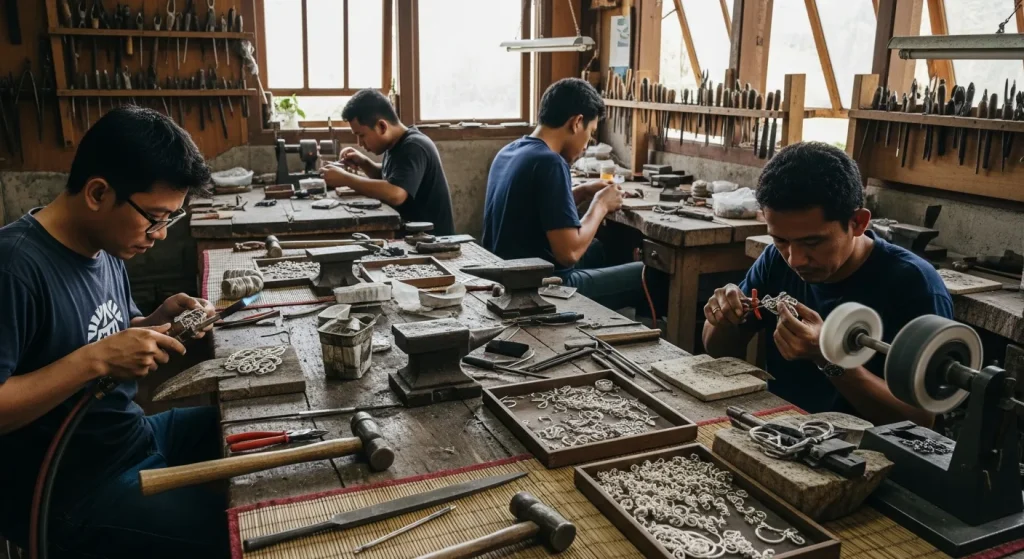
Bali is renowned for its intricate silverwork, particularly the Celuk style, which involves granulation and filigree techniques. Balinese silversmiths often incorporate traditional motifs inspired by Hindu mythology, nature, and local artistry. The craftsmanship is typically labour-intensive, with pieces often made by hand from start to finish. This results in unique, individual items rather than mass-produced uniformity. The emphasis is on detailed textures, oxidised finishes to enhance depth, and often the integration of natural gemstones.
Thai Silver Jewelry Craftsmanship
Thai silver jewelry encompasses a broader range of styles. Northern Thailand, particularly Chiang Mai, is known for its high-purity (often 95-99% silver) tribal silver, which features bolder, hand-stamped, and hammered designs. Bangkok, on the other hand, hosts larger manufacturing facilities that produce a wider variety of designs, from contemporary minimalist pieces to more ornate, gem-set items. Thai craftsmanship can range from artisanal hand-worked pieces to semi-mechanised production, allowing for greater volume and consistency in certain design categories. The design aesthetic often leans towards modern trends, combined with traditional Thai patterns.
3. Material Standards and Durability
Bali Silver Jewelry Standards
Bali silver jewelry primarily uses sterling silver (925), meaning 92.5% pure silver and 7.5% other metals, typically copper. This alloy provides the necessary hardness and durability for daily wear while retaining the lustre of silver. The traditional techniques used, such as solid construction and careful soldering, contribute to the structural integrity of the pieces. Oxidisation, a common finish, not only enhances design details but also provides a protective layer, reducing the rate of tarnishing. Proper care, including avoiding harsh chemicals and storing in airtight conditions, ensures long-term durability.
Thai Silver Jewelry Standards
Thai silver jewelry also extensively uses sterling silver (925). However, some regions, particularly those producing tribal silver, may use higher purities, such as 95-99% fine silver. While higher purity silver is softer and more prone to scratching and bending, it is also less likely to tarnish. For mass-produced sterling silver, Thai manufacturers adhere to international standards for alloy composition. The durability of Thai silver jewelry varies depending on the purity of silver used and the manufacturing process. Machine-made components offer consistency, while handcrafted pieces rely on the skill of the artisan. Finishes can include high polish, matte, or oxidised, each impacting the piece’s long-term appearance and maintenance requirements.
4. Pricing Structures and Minimum Order Requirements
Pricing for silver jewelry is influenced by several factors: the fluctuating price of raw silver, labour costs, design complexity, and production volume. For wholesale buyers, understanding these dynamics is crucial.
Bali Silver Jewelry Wholesale Pricing
Due to its handcrafted nature and intricate designs, Bali silver jewelry often commands a higher price per piece compared to simpler, mass-produced items. The labour involved in granulation, filigree, and detailed finishing contributes significantly to the cost. Bali Silver Jewelry Wholesale operates on a B2B model, catering to importers and trade buyers. Our bali silver jewelry minimum order requirements are structured to support wholesale transactions, typically involving a minimum quantity per design or a total order value. Exact figures vary based on product complexity and current silver market rates, but we work with buyers to meet their specific needs while maintaining sustainable production for our artisans. Generally, expect minimum order quantities to ensure efficient production runs and competitive wholesale pricing.
Thai Silver Jewelry Wholesale Pricing
Thai silver jewelry pricing can be more varied. High-purity tribal silver, due to its material content and handcrafted nature, can be competitively priced. Mass-produced sterling silver from larger factories in Thailand often benefits from economies of scale, leading to lower unit costs for simpler designs and higher volumes. Thai suppliers typically have clear minimum order quantities (MOQs) which can be lower for standard catalogue items and higher for custom designs. The availability of both artisanal and industrial production allows for a wider range of pricing tiers, accommodating different wholesale budgets and scales of operation.
5. Supply Chain and Ethical Sourcing Considerations
Bali Silver Jewelry Supply Chain
The supply chain for Bali silver jewelry is often characterised by small workshops and individual artisans. This model allows for greater transparency and direct engagement with the makers. Ethical sourcing in Bali focuses on fair wages, safe working conditions, and supporting local communities. Buyers can often trace the origin of their pieces and understand the social impact of their purchases. Bali Silver Jewelry Wholesale prioritises these ethical considerations, ensuring that our artisans are compensated fairly and work in supportive environments. This commitment aligns with growing consumer demand for ethically produced goods.
Thai Silver Jewelry Supply Chain
Thailand’s silver jewelry supply chain is more diverse, ranging from small family workshops to large-scale factories. Ethical sourcing initiatives in Thailand focus on similar principles: fair labour practices, environmental responsibility, and transparent supply chains. Larger manufacturers often have certifications or adhere to international standards regarding labour and environmental practices. For tribal silver, direct relationships with artisan communities are also common. Buyers sourcing from Thailand should inquire about the supplier’s ethical practices and certifications to ensure compliance with their own company values and consumer expectations.
Summary Table: Bali vs. Thai Silver Jewelry (2027 Outlook)
| Feature | Bali Silver Jewelry (2027) | Thai Silver Jewelry (2027) |
|---|---|---|
| Craftsmanship Focus | Intricate, handcrafted Celuk style, granulation, filigree; cultural/mythological motifs. | Diverse: bold tribal (high purity), modern mass-produced, contemporary designs. |
| Primary Material | Sterling Silver (925) | Sterling Silver (925); high-purity (95-99%) for tribal styles. |
| Durability | Robust due to solid construction, traditional techniques, oxidisation for protection. | Varies by purity (higher purity softer); consistent for mass-produced 925. |
| Pricing (Wholesale) | Higher per piece due to intricate hand labour; competitive for unique artisanal items. | Varied: competitive for mass-produced; higher for high-purity or complex artisanal. |
| Minimum Order (Bali Silver Jewelry Minimum Order) | Structured for wholesale, based on design quantity or total value. | Typically clear MOQs, potentially lower for standard items, higher for custom. |
| Supply Chain | Small workshops, direct artisan engagement, strong ethical sourcing focus. | Diverse: small workshops to large factories; varying ethical certifications. |
| Market Positioning | High-margin, artisanal export niche; unique, culturally rich products. | Broad market appeal; caters to both artisanal and volume-driven demand. |
Conclusion for Trade Buyers
Both Bali and Thailand offer compelling options for wholesale silver jewelry buyers in 2027. Bali excels in providing unique, handcrafted sterling silver pieces with deep cultural significance and intricate designs, ideal for clients seeking high-value, artisanal products. Thailand offers a broader spectrum, from distinctive high-purity tribal silver to efficient mass production of contemporary sterling silver designs. Your choice will depend on your target market, desired volume, pricing strategy, and commitment to specific craftsmanship styles.
For inquiries regarding Bali silver jewelry minimum order requirements, custom designs, or to understand our wholesale pricing, please request a wholesale quote on WhatsApp. We are committed to providing transparent information and high-quality products to our international trade partners.