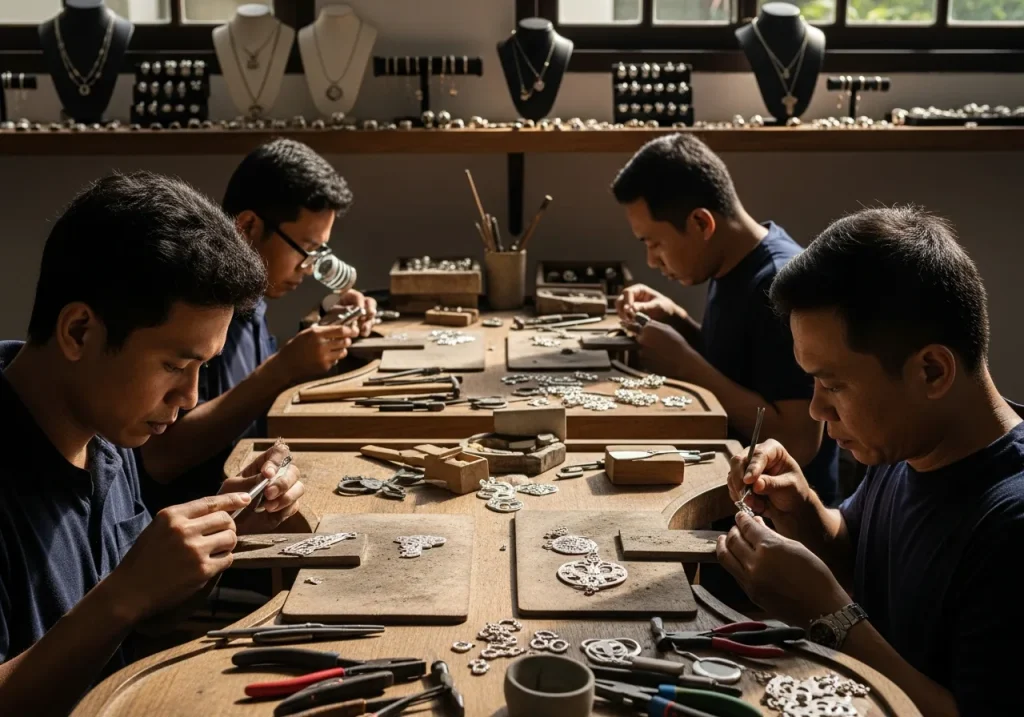
The global silver jewelry market is projected to reach USD 43.76 billion in 2026, with sterling silver (925) alone valued at USD 16.96 billion. Asia-Pacific accounts for over 40% of global consumption. Indonesia, particularly Bali, maintains a small but growing artisanal export niche, focusing on cultural craftsmanship and heritage-based designs, aligning with Asia-Pacific’s demand growth.
Buyer Guide: Best Celuk Village Artisans for Premium Bali Silver Jewelry Wholesale
As Made Wirawan, Celuk master silversmith and senior content lead for Bali Silver Jewelry Wholesale, I provide insights for importers, wholesalers, retailers, interior contractors, and trade buyers seeking premium Bali silver jewelry. The Indonesian silver jewelry wholesale segment, specifically from Bali, is a distinct export-oriented niche within a rapidly expanding global market. This market is experiencing 4.6–5.4% annual global growth, driven significantly by strong Asia-Pacific demand, a trend projected to continue into 2027.
The Global Silver Jewelry Market in 2026–2027
Understanding the broader market context is crucial for buyers. The global silver jewelry market is forecast to achieve a value of USD 43.76 billion in 2026. Projections indicate a rise to USD 65.43 billion by 2035, demonstrating a Compound Annual Growth Rate (CAGR) of approximately 4.6% between 2026 and 2035. Global silver jewelry fabrication surpassed 240 million ounces in 2023 and is expected to reach around 248.6 million ounces by 2026, representing the highest demand observed in over a decade.
The Asia-Pacific region is a dominant force, contributing over 40% of global silver jewelry consumption. This share significantly exceeds North America’s approximately 38% and Europe’s approximately 20%. This regional demand is a key driver for artisanal hubs like Bali.
Sterling Silver (925) Segment Growth
Within the broader market, the sterling silver jewelry segment (925 purity) is particularly robust. This segment was valued at USD 16.09 billion in 2025 and is projected to reach USD 16.96 billion in 2026. By 2035, it is expected to grow to USD 27.23 billion, reflecting a CAGR of 5.4% from 2026 to 2035. This sustained growth in sterling silver underscores its importance for wholesale buyers focusing on quality and enduring value.
Bali’s Position in the Global Market (2026)
Indonesia’s sterling silver jewelry market is distinguished by its emphasis on cultural craftsmanship and heritage-based motifs. Bali and Yogyakarta are the primary artisanal centers. The country’s tourist economy also fuels substantial demand for handcrafted sterling silver jewelry, purchased as souvenirs and cultural collectibles. Concurrently, urban youth are increasingly purchasing affordable fashion silver jewelry. While large-scale industrial manufacturing remains limited in Indonesia, the nation’s strength lies in its handmade, artisanal export niche, with Bali being a prominent example.
Concrete country-level market size data specifically for Indonesia or Bali is not disaggregated in available reports. However, considering Indonesia’s role as an artisanal hub within Asia-Pacific and the global dominance of large players in mass production, Bali’s wholesale export segment can be accurately characterized as small but high-margin and growing in alignment with Asia-Pacific’s greater than 4% annual demand growth.
2027 Note
By 2027, the global silver jewelry market is anticipated to continue its upward trajectory, with fabrication exceeding previous highs. Buyers should note the sustained demand from Asia-Pacific, which will continue to underpin the export potential of Bali’s artisanal silver. The focus on cultural craftsmanship from regions like Celuk will remain a key differentiator in a competitive market.
The Celuk Village Advantage for Wholesale Buyers
Celuk Village, located in Sukawati, Gianyar, Bali, has been the epicentre of Balinese silversmithing for centuries. This village is renowned for its generational knowledge and sophisticated craftsmanship in creating intricate silver and gold jewelry. For wholesale buyers, understanding the unique attributes of Celuk is paramount.
Artisanal Heritage and Techniques
Celuk artisans employ traditional techniques passed down through families. These include:
- Filigree: Delicate wires of silver are twisted and soldered into intricate patterns. This technique requires significant precision and skill.
- Granulation: Tiny spheres of silver are fused onto a surface to create textured designs. This method, often seen in ancient jewelry, adds depth and visual interest.
- Repoussé and Chasing: Metal is hammered from the reverse side (repoussé) and then refined from the front (chasing) to create three-dimensional designs.
- Lost-wax casting: A wax model is created, encased in a mould, and then melted away, allowing molten silver to fill the cavity. This technique is used for complex, sculptural pieces.
These techniques ensure that each piece of Bali silver jewelry from Celuk is not merely an item but a work of art, carrying the legacy of Balinese craftsmanship. This focus on handcrafted quality differentiates Bali silver from mass-produced alternatives, appealing to buyers seeking unique, high-value products.
Identifying Premium Artisans for Wholesale Purchase
For trade buyers, selecting the right artisan or workshop in Celuk is critical. Here are factors to consider:
1. Craftsmanship Standards
Premium artisans demonstrate meticulous attention to detail. Examine the soldering points, the consistency of filigree work, and the polish. High-quality Bali silver jewelry should have no rough edges, inconsistent finishes, or visible flaws. The weight and feel of the piece also indicate the quality of materials and construction.
2. Design Originality and Cultural Authenticity
While many artisans produce traditional designs, premium workshops often offer unique interpretations or innovative designs rooted in Balinese culture. Look for pieces that reflect genuine Balinese motifs – such as flora, fauna, mythological figures, or traditional patterns – rather than generic imitations. Authenticity adds significant value for end-consumers.
3. Material Purity and Sourcing
Reputable artisans and wholesalers will guarantee the purity of their silver, typically 925 sterling silver. They should be transparent about their material sourcing. Ethical sourcing practices are increasingly important for consumers and trade buyers alike. Confirming material purity ensures you are offering genuine sterling silver to your clientele.
4. Production Capacity and Consistency
For wholesale orders, assessing an artisan’s production capacity and ability to maintain consistent quality across larger volumes is essential. Discuss lead times, minimum order quantities (MOQs), and their process for quality control. A reliable partner can scale production without compromising the artisanal quality that defines Bali silver.
5. Communication and Reliability
Clear communication is paramount in B2B transactions. Choose partners who are responsive, transparent about their processes, and reliable in meeting deadlines. This fosters a strong, long-term wholesale relationship.
The Wholesale Advantage: Why Bali Silver Jewelry Wholesale
As a B2B export house, Bali Silver Jewelry Wholesale bridges the gap between these master artisans in Celuk and international buyers. We offer:
- Curated Selection: Access to a vetted network of Celuk’s finest silversmiths, ensuring premium quality and authentic designs.
- Quality Assurance: Rigorous quality control protocols to meet international standards for material purity and craftsmanship.
- Efficient Logistics: Streamlined export processes, including packaging, customs, and international shipping, to deliver your orders reliably worldwide.
- Custom Design & Development: Collaboration with artisans to develop exclusive designs tailored to your market’s specific requirements.
- Competitive Wholesale Pricing: Direct access to artisanal production at advantageous wholesale rates, without compromising on quality.
We understand the nuances of the global silver jewelry market, particularly the sterling silver segment’s approximate 5.4% CAGR from 2026–2035. Our expertise ensures that your wholesale purchase aligns with market trends and consumer demand for authentic, high-quality artisanal products.
Key Considerations for Wholesale Orders
For importers and trade buyers, several practical aspects require attention when placing wholesale orders for Bali silver jewelry:
| Aspect | Detail |
|---|---|
| Minimum Order Quantity (MOQ) | Varies by artisan/design; typically negotiable for long-term partners. |
| Payment Terms | Standard B2B terms (e.g., deposit, balance upon shipment); discussed per order. |
| Lead Time | Dependent on order size and complexity; generally 4-12 weeks for custom or large orders. |
| Customisation | Available for design modifications, metal type (sterling silver 925), and finishes. |
| Packaging | Standard export packaging to ensure safe transit; custom packaging available. |
| Shipping | International air freight or sea cargo; choice depends on urgency and volume. |
Working with an established export house like Bali Silver Jewelry Wholesale simplifies these complexities, providing a single point of contact for all your sourcing needs.
Choosing Bali silver jewelry wholesale from Celuk means investing in pieces that carry cultural significance and exceptional craftsmanship. The global market, particularly the Asia-Pacific region, continues to show strong demand for such authentic products. Partner with us to access the best of Balinese silversmithing. For specific inquiries or to discuss your wholesale requirements, request a wholesale quote on WhatsApp.